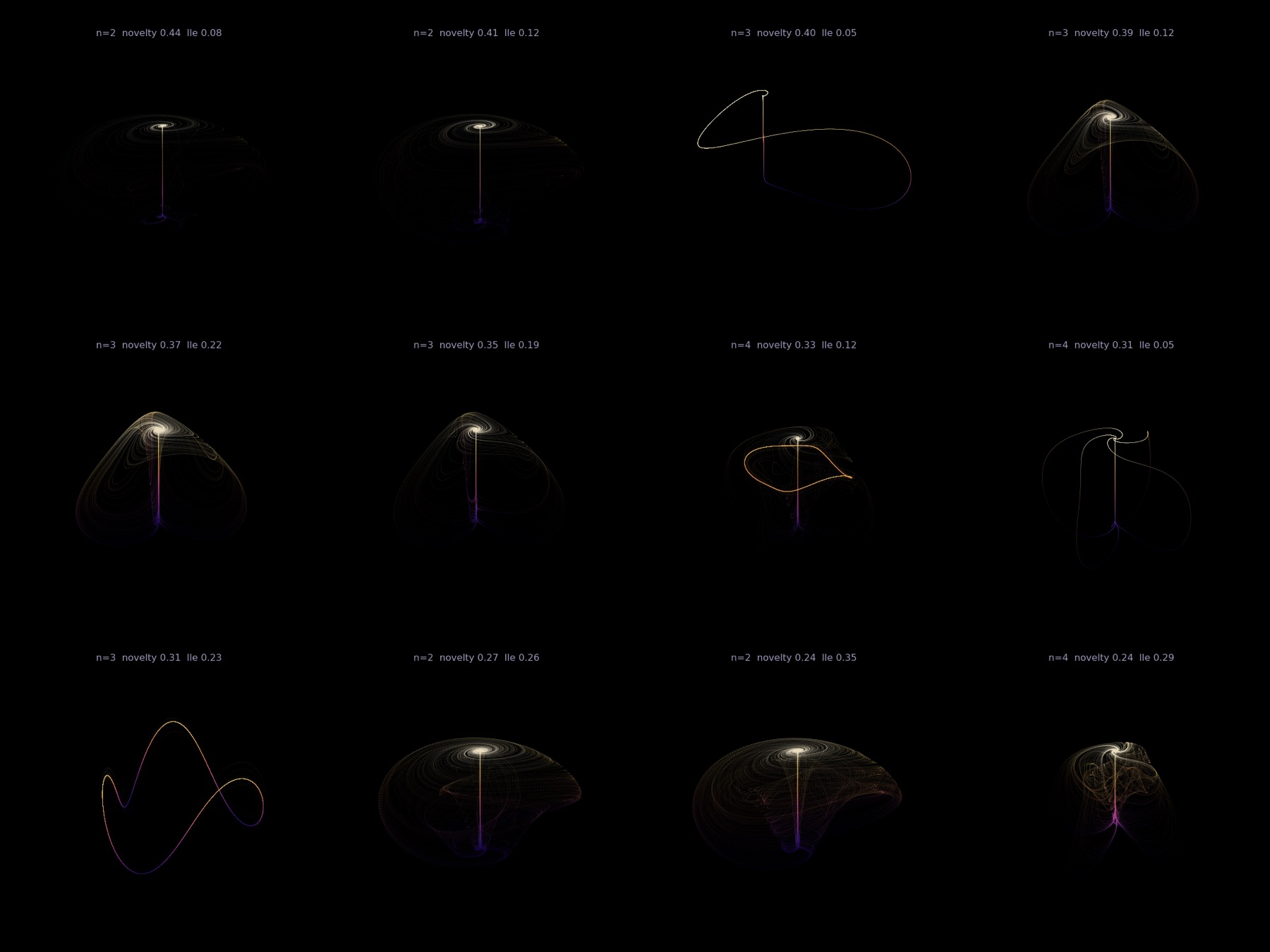
The Attractor Atlas

A periodic table of strange attractors

The Attractor Atlas

Four chaotic flows, each carrying the symmetry of a sea creature, found by an engine that searches for beauty and certified by arithmetic.

Four certified specimens · one symmetry law · discovered June 2026

A strange attractor is the shape a chaotic system settles into: never repeating, never escaping, folded into infinitely many layers.

Most of them are found by accident. This project went looking on purpose. The premise was simple and a little stubborn: pick a symmetry first, then search a whole family of equations for the rare members that are genuinely chaotic, bounded forever, and beautiful enough to keep. Four of them earned names. Each looks, from the right angle, like something that has drifted through the oceans for half a billion years.

What follows is the field guide to those four, the machine that hunts them, and the wall that appeared when the search tried to climb from the flat symmetries of the plane to the Platonic solids. The wall turned out to be the most interesting thing in the atlas.

Aurelia

C₃ · three-fold rotation

Aurelia aurita · the moon jellyfish

Aurelia, one full turn. Gold, three-fold.
Largest exponent
λ₁ = 0.233
Dimension
D_KY ≈ 2.07
Nearest known
0.184 from Aizawa

Aurelia was the first. A three-dimensional flow with a quadratic twist in the plane and a cubic clamp on the axis, it spins everything around a single motionless point at its centre, an unstable spiral that pushes orbits outward only to have the nonlinear terms fold them back. That one point holds the whole bell together by pushing everything away.

The three-fold symmetry is not decoration. It is built into the equations through a resonant coupling term, the same algebra that governs how three waves exchange energy. Asked for its nearest relative among 135 catalogued systems, the project's own metric answered: the Aizawa attractor, at a distance of 0.184. Out at the rim of shape space, that is what isolation looks like.
Naiad

C₂ · two-fold rotation

Naiad · the water nymph of springs and fountains

Naiad, one full turn. Two lobes exchanged by a half-turn.
Largest exponent
λ₁ = 0.296
Symmetry
half-turn C₂
Homoclinic
returns to 7×10⁻⁵

The quality-diversity engine found Naiad while exploring the two-fold corner of the family. It arcs like water leaving a fountain and falling back, the two halves not mirror images but half-turns of each other.

Naiad is the closest the atlas comes to a proof of mechanism. Shooting the unstable manifold out from its central equilibrium and sweeping the rotation rate, the trajectory comes back to within seven hundred-thousandths of where it started, with a ladder of seven near-misses stacked below the canonical parameter. A homoclinic connection, the ingredient Shilnikov's theorem needs to guarantee chaos, almost certainly threads this system.

Cassiopea

C₄ · four-fold rotation

Cassiopea · the upside-down jellyfish

Cassiopea, one full turn. The four-fold member.
Largest exponent
λ₁ = 0.525
Symmetry
quarter-turn C₄
Stretches
hardest of the four

Cassiopea has four arms and the most violent chaos in the family. Its largest Lyapunov exponent, 0.525, is more than double Aurelia's, which is the first crack in an assumption you might have made: that more symmetry should mean more order, that a four-fold system ought to be calmer than a three-fold one. It is not. The chaos does not climb with the order of the symmetry. It wanders.

Off its central axis stand four distant saddle points, arranged in a perfect square that the attractor itself never touches. They may organize the boundary of its basin. Nobody has looked yet.

Mobula

S₄ · rotoreflection

Mobula · the devil ray, which breaches and somersaults clear of the water

Mobula, one full turn. The spin and the flip, made visible.
Largest exponent
λ₁ = 0.330
Dimension
D_KY = 2.27
Novelty
0.273, beyond Aurelia

The first three are pure rotations. Mobula is rarer: its symmetry is a quarter-turn married to a flip. Rotate it ninety degrees about the vertical axis and turn it upside down, and it lands back on itself, but neither the quarter-turn alone nor the flip alone is a symmetry. That improper operation, called S₄, is the motion of a devil ray breaching and somersaulting clear of the surface, a spin and a flip at once.

Proving the symmetry is real and not a trick of the eye took a new kind of evidence. The certification measures how far the attractor moves when its symmetry operation is applied to the point cloud: 0.0136 of its own size, against 0.0455 when a plain flip is applied instead. The rotoreflection maps the cloud onto itself more than three times better than the flip does. By the fingerprint ruler, Mobula sits 0.273 from anything known, more novel than Aurelia herself.

The polyhedral wall

Then the search tried to climb to the Platonic solids, and hit a wall.

The plan was to keep going: a strange attractor with the symmetry of a tetrahedron, then an octahedron, then the intended centrepiece of the whole project, an icosahedron, sixty rotations deep, the symmetry of a virus shell and a radiolarian's glass skeleton. The equivariant families were built. A test proved each one carried exactly the right symmetry, to machine precision, including an icosahedral invariant assembled by hand from all sixty rotation matrices. Then the search for chaos was switched on, and nothing came back. Not nothing beautiful. Nothing at all.

The reason is a wall, and it had been hiding in the project's own one-line caution. The cyclic and rotoreflection groups act on space reducibly: they spin a plane and leave a height axis alone. That split is what makes the four jellyfish work. It gives them a contraction-and-rotation engine in the plane and a fold along the axis. The Platonic groups act irreducibly. There is no plane they preserve, no axis they leave alone. A theorem of Schur then says that anything linear which commutes with the symmetry must be a single number in every direction, a balloon. The engine that made the jellyfish chaotic is, for the polyhedra, mathematically forbidden.

Near the centre, the only place a symmetric attractor could live, every direction simply expands at one rate. The symmetric place is the calm place.

An exhaustive search confirmed it the hard way. Across roughly a hundred thousand parameter sets, in polynomial families and trigonometric ones, every bounded orbit relaxed to a fixed point or a closed loop. The chaos that did appear was a mirage: at a coarse integration step a candidate would report a healthy positive Lyapunov exponent, and halving the step would collapse it to a stable equilibrium. Every apparent hit reversed sign as the arithmetic got finer. What the polyhedral groups will host is the rung just below chaos: equilibria and symmetric limit cycles, which can carry all sixty rotations. Chaos cannot. This is, almost certainly, why the literature has chaotic maps with polyhedral symmetry and no chaotic flows.

The law of the cliff

Give every symmetry the same search budget and the wall becomes a measurement.

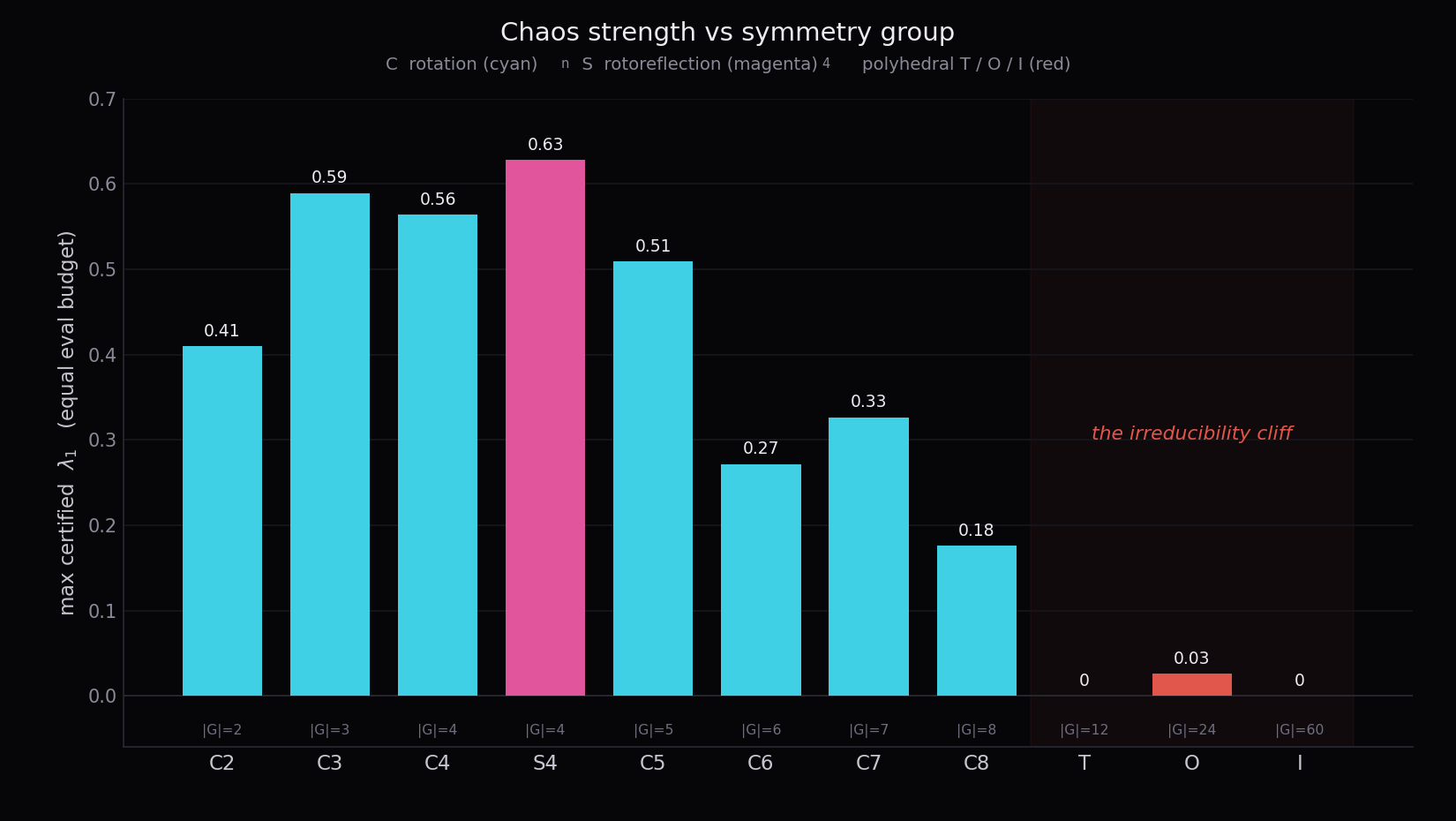
The same engine ran against eleven symmetry groups under one rule: identical settings, identical number of candidate flows, and the same fine-step re-certification that catches the integration mirages. For each group, record only the strongest chaos that survives. Plotted against the group, the result is not a trend. It is a cliff.

Bar chart of maximum certified largest Lyapunov exponent per symmetry group. Cyan cyclic groups and the magenta rotoreflection group range from 0.18 to 0.63 with a non-monotonic shape. The red polyhedral groups T, O, and I sit at essentially zero, marked the irreducibility cliff.
Max certified λ₁ under equal budget. Reducible-action groups host chaos non-monotonically; the irreducible polyhedral groups fall to the floor.

Two regimes, split by a sharp boundary. The reducible groups, the cyclic family and the rotoreflection, host chaos with a strength that wanders between 0.18 and 0.63 and refuses to march in step with the order of the symmetry. The irreducible polyhedral groups sit at the floor. The amount of chaos a symmetry will permit depends less on how much symmetry there is than on what kind it is. The wandering line and the cliff are the same finding, seen twice.

Under the hood

How the atlas was actually made, including the parts that nearly went wrong.

The engine

A search that prizes novelty

Specimens are found by quality-diversity search over an equivariant family: thousands of candidate flows per generation, each integrated, tested for bounded chaos, then fingerprinted. Novelty is scored as the distance from a candidate's shape to its nearest neighbour among 135 catalogued systems, so the engine is rewarded for finding things genuinely unlike what is known, not merely things that are chaotic.

Certification

Papers in order before a name

Nothing is named until it passes the full battery: a long Lyapunov spectrum by the tangent-space method, a Kaplan-Yorke dimension, boundedness over four million steps, robustness across scattered initial conditions, and a symmetry residual that measures how exactly the cloud maps onto itself. Every number on this page comes from a script in the repository.

The mirage

Chaos that was an arithmetic error

The hardest hurdle was a false positive. The fast batch estimator, run at a coarse time step, manufactured chaos around stable equilibria: a candidate reading a positive exponent of 0.4 would collapse to minus 20, a fixed point, once the step size was halved. The fix was a rule, now baked in: trust no exponent until it survives a finer step. It is what let the project tell a real attractor from a numerical ghost.

The icosahedron

An invariant built from sixty matrices

The icosahedral group has no simple low-degree invariant to push the flow with. The lowest one sits at degree six, the same fact behind the soccer-ball symmetry of C₆₀. Rather than look it up, the project built it numerically: take a generic direction, sweep it through all sixty rotations, and sum the sixth powers. The result is icosahedrally symmetric by construction, and verified so against the whole group.